KNKA APH4000 Air Purifier Review: High Airflow for Less, but There Are Important Trade-Offs
Choosing an air purifier gets surprisingly complicated once you look beyond the marketing. A machine can advertise thousands of square feet of coverage while being much better suited to a single bedroom. A purifier can have a True HEPA filter but still be disappointing if your main problem is strong odors. And a machine can be extremely quiet at night while becoming noticeably loud when you actually need maximum airflow.
That is essentially the story I found with the KNKA APH4000.
After going through its airflow specifications, filtration system, maintenance requirements, reported performance, competing models, and the recurring patterns in user feedback, I think this is a particularly interesting purifier for people who care about particle removal, pet dander, dust, pollen, and high airflow at a relatively low price.
But I wouldn’t buy it based on the advertised 1,695- or 3,500-square-foot coverage. And I wouldn’t choose it if heavy smoke or strong chemical odors were my primary concern.
So the question isn’t whether the APH4000 is good or bad. It’s whether its particular combination of strengths matches what you actually need.
My overall rating
My take: A very compelling budget-to-mid-range option for particle filtration and pet-related airborne debris, with unusually strong airflow for the money. Its limitations with heavy odors, smart features, ECO Mode, and oversized coverage claims keep it from being an all-around winner.
Overviews
KNKA Air Purifier for Home Bedroom


KNKA APH4000 at a glance
| Specification | AP4000 | What it means |
|---|---|---|
| Smoke/Dust CADR | 226 CFM | Strong particle-clearing airflow |
| Pollen CADR | 242–244 CFM | Strong allergen-focused airflow |
| Main filtration | H13 True HEPA | Targets fine airborne particles |
| Pre-filter | Washable nylon mesh | Useful for hair, lint and larger dust |
| Carbon filtration | Carbon-impregnated sheet | Better suited to lighter odors |
| Sleep Mode | 22–24 dB | Very quiet overnight setting |
| Power | 45 W | Moderate electricity consumption |
| Weight | 9.68 lb | Easy to move between rooms |
| Realistic effective area | ~350–375 sq. ft. | Based on the 4.8 ACH benchmark |
| Smart features | None | Physical controls only |
How I’d rate each part of the APH4000
| Category | Rating | My assessment |
|---|---|---|
| Particle filtration | ★★★★★ | One of its strongest reasons to buy |
| Airflow/CADR | ★★★★★ | Excellent value for the price |
| Pet use | ★★★★★ | Washable pre-filter is particularly useful |
| Noise | ★★★★☆ | Excellent in Sleep Mode, loud at maximum |
| Odor control | ★★★☆☆ | Fine for lighter odors, weak for heavy VOC loads |
| Ease of use | ★★★★★ | Very simple physical controls |
| Smart features | ★★☆☆☆ | No Wi-Fi, Bluetooth or app |
| Maintenance cost | ★★★★☆ | Replacement filters are relatively inexpensive |
| Overall value | ★★★★☆ | Strong if its limitations match your needs |
The first thing I’d question is the coverage claim
The APH4000 is advertised with coverage figures as high as 3,500 square feet, with other marketing versions citing 1,695 square feet. Those numbers immediately caught my attention because they don’t tell the whole story.
Coverage depends on how frequently the purifier can turn over the air in the room. A purifier that technically processes enough air to serve a huge area at one air change per hour is not equivalent to a purifier providing nearly five air changes per hour in the same space.
For allergy control and meaningful particle reduction, the research uses the AHAM benchmark of approximately 4.8 ACH. Applying that to the APH4000’s CADR produces a much more realistic effective area of roughly 350–375 square feet with standard eight-foot ceilings.
That’s the number I’d use when deciding whether the machine is appropriately sized.
| Claim/measurement | Area | How I’d interpret it |
|---|---|---|
| Manufacturer marketing | Up to 3,500 sq. ft. | Too optimistic for serious air cleaning |
| Alternative marketing figure | 1,695 sq. ft. | Still based on low air-change assumptions |
| AHAM-oriented calculation | ~350–375 sq. ft. | The figure I’d actually use when shopping |
Why the dual-intake design matters
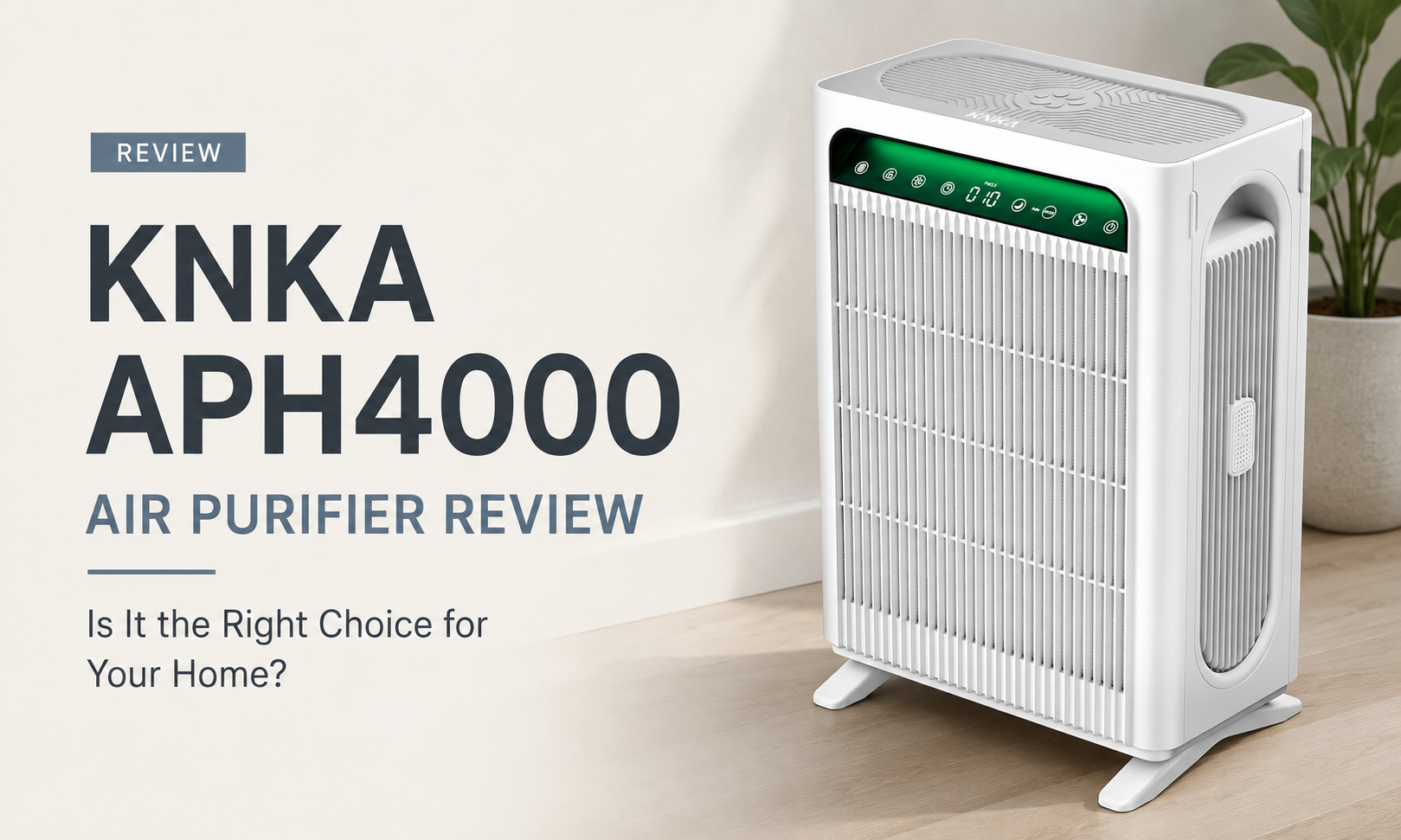
The APH4000 draws air through both the front and rear of the machine and releases filtered air through side outlets. This bilateral airflow arrangement increases the available intake area and helps reduce the airflow bottleneck that can occur when a purifier tries to pull a large volume of air through a smaller intake.
That matters because filtration is only useful if enough room air actually passes through the filters.
The APH4000’s 226 CFM smoke/dust CADR is therefore one of the specifications I find most convincing. The machine isn’t relying on a premium app or a complicated ecosystem to justify its price. The hardware is focused on moving air.
The filtration setup is particularly good for dust and pet dander
The APH4000 uses two filter cartridges simultaneously. Each cartridge incorporates a washable fine-mesh pre-filter, H13 True HEPA filtration, and activated carbon.
The washable pre-filter is especially relevant for pet owners. Dog and cat hair can quickly accumulate around an air purifier, and having a removable mesh layer that can be washed means larger debris doesn’t immediately become a reason to replace the main filtration media.
The H13 HEPA layer then handles much smaller particles. The research specifies a 99.97% capture rate for airborne particles down to 0.3 microns, making this the stage that matters most for pollen, mold spores, fine dust, and PM2.5.
For someone primarily concerned with airborne particles, this is where I’d expect the APH4000 to make the strongest case for itself.
Where the APH4000 falls short: heavy odors
The activated carbon layer is much less impressive than the HEPA component.
The APH4000 uses a carbon-impregnated fibrous sheet rather than a deep bed of granular carbon pellets. That doesn’t mean the carbon filter is useless. It can help with transient household odors. The limitation is capacity.
If the source of an odor is continuous, a relatively small amount of carbon can become saturated much faster. This explains why feedback about odor performance is so divided.
| Situation | My expectation | Why |
|---|---|---|
| Light cooking odors | Reasonable | Temporary source is easier for a thin carbon layer to handle |
| Mild pet odors | Reasonable | Can help with lighter intermittent odors |
| Heavy cigarette smoke | Poor fit | Continuous chemical load can overwhelm thin carbon media |
| Strong chemical VOCs | Poor fit | Insufficient carbon mass for sustained heavy loads |
| Persistent marijuana odor | Poor fit | Continuous odor generation can quickly saturate the carbon |
Sleep Mode is genuinely useful
The APH4000’s Sleep Mode is rated at approximately 22–24 dB. That’s one of the specifications that would make me comfortable considering it for a bedroom.
More importantly, the display can be completely turned off without stopping filtration. For light-sensitive sleepers, this is much more useful than a simple dimming feature.
Maximum fan speeds are a different story. Turbo and Pet Mode generate significant aerodynamic noise because the machine is moving a large volume of air. I wouldn’t consider that unusual, but it’s something I’d factor into placement.
| Mode | Expected experience | Best use |
|---|---|---|
| Sleep | 22–24 dB, very quiet | Bedroom overnight |
| Medium | Comparable to a typical pedestal fan | Continuous daytime filtration |
| Turbo/Pet | Loud aerodynamic airflow | Quick particle clearance |
One feature I’d probably avoid: ECO Mode
ECO Mode sounds attractive because it is designed to conserve electricity by shutting the blower off when the air remains clean.
The problem is that a stationary purifier isn’t circulating the room’s air.
The APH4000’s infrared sensor measures particles that reach its sensing area. If the blower is off and a pollutant event occurs across the room, the machine has to wait for those particles to drift naturally toward the sensor.
For me, that makes continuous low-speed operation more appealing than ECO Mode when maintaining consistent room circulation is the priority.
Simple operation is actually one of its strengths
There is no companion app, Wi-Fi setup, Bluetooth pairing, or account creation. The controls are physical capacitive buttons, with straightforward icons for fan speed, Sleep Mode, and Pet Mode.
Some buyers will see the lack of connectivity as a disadvantage. I wouldn’t necessarily.
If I wanted a purifier that I could simply plug in and operate without another app or smart-home account, this approach would be refreshing.
| Feature | AP4000 | Why it matters |
|---|---|---|
| True HEPA filtration | ✓ | Fine-particle filtration |
| Washable pre-filter | ✓ | Useful for pet hair and larger debris |
| Activated carbon | ✓ | Helps with lighter odors |
| PM2.5 display | ✓ | Provides real-time local particle information |
| Auto Mode | ✓ | Automatically adjusts fan based on sensor readings |
| Pet Mode | ✓ | High airflow for particle-heavy situations |
| Wi-Fi/app | ✕ | No remote control or smart automation |
| Voice assistant integration | ✕ | No Alexa or Google Home integration |
Maintenance looks relatively inexpensive
The APH4000 uses two filter cartridges, and both need to be replaced together. The manufacturer rates them for approximately six to eight months under normal residential conditions.
Replacement two-packs reportedly cost around $30.99–$42.99, depending on pricing and filter variation. Using two complete sets annually would put the estimated filter cost around $60–$85 per year.
That is one of the APH4000’s better ownership characteristics, particularly compared with premium machines where individual replacement filters can cost considerably more.
| Maintenance item | Frequency | Estimated cost |
|---|---|---|
| Washable pre-filter | Every 2–4 weeks | No replacement cost |
| Main filter cartridges | Every 6–8 months | Approximately $30.99–$42.99 per 2-pack |
| Estimated annual filters | About 2 sets/year | Approximately $60–$85 |
The design is practical rather than premium
The APH4000 uses a rectangular tower design made primarily from polymer materials. I wouldn’t expect it to feel like a luxury appliance, but the research indicates that the chassis is sufficiently rigid to avoid obvious structural flexing or panel vibration.
The relatively low 9.68-pound weight and built-in handle areas are useful if I wanted to move the purifier from the living room during the day to the bedroom at night.
One unusual design decision is the external 24V AC/DC power adapter. It’s similar to a laptop power brick. The arrangement keeps the voltage conversion outside the main chassis, but it also creates another component that has to sit somewhere on the floor.
I’d call that a minor annoyance rather than a major problem.
How it compares with the competition
| Model | Approx. price | CADR | Effective area | Main advantage |
|---|---|---|---|---|
| KNKA APH4000 | ~$130–$150 | 226 CFM | ~350 sq. ft. | Airflow/value |
| Winix 5500-2 | ~$160–$200 | 247 CFM | ~360 sq. ft. | Heavy odor control |
| Levoit Core 300S | ~$150 | 141 CFM | ~219 sq. ft. | Smart-home integration |
| Levoit Core 400S | ~$220 | 260 CFM | ~403 sq. ft. | Airflow + smart features |
The comparison with the Winix 5500-2 is especially revealing. The Winix has slightly higher CADR and uses a much more substantial washable pellet carbon filter, making it the stronger choice if smoke and serious odors are important. The KNKA’s advantage is that it generally costs less and offers strong particle performance for the money.
The Levoit Core 300S is almost the opposite proposition. It gives up a substantial amount of raw airflow but adds smart-home functionality and a more advanced sensor approach. The Core 400S is the more expensive route for someone who wants both higher airflow and smart features.
Who I’d recommend it to
| Buyer type | Fit | Reason |
|---|---|---|
| Pet owners | ★★★★★ | Strong airflow plus washable pre-filter |
| Allergy-focused users | ★★★★★ | H13 HEPA and high particle CADR |
| Light sleepers | ★★★★★ | Quiet Sleep Mode and fully dark display |
| Budget buyers | ★★★★★ | High CADR for the purchase price |
| Smart-home users | ★★☆☆☆ | No app, Wi-Fi or voice integration |
| Heavy smokers | ★☆☆☆☆ | Carbon layer is not designed for heavy continuous odors |
Who should probably avoid it?
I would not choose the APH4000 if my primary goal were eliminating heavy cigarette smoke or persistent VOCs. The HEPA filter can address particulate matter, but the thin carbon layer is the limiting factor for serious odor control.
I’d also choose another model if I wanted to control the purifier remotely or integrate it with a smart-home system.
Finally, I would avoid buying it as a whole-house solution based solely on its headline coverage claim. The more realistic 4.8 ACH calculation puts the machine in the medium-room category.
What about long-term reliability?
The research doesn’t provide enough evidence to make a confident five- or ten-year durability prediction. The basic motor and chassis appear reasonably straightforward, and there are relatively few reports of premature motor failure, but KNKA doesn’t have the same long-established market history as some major purifier manufacturers.
There is also a reported long-term sensor concern. Infrared sensors can accumulate dust over time, and some owners have experienced readings becoming stuck at very poor air-quality levels. In those cases, the purifier may run continuously at high speed in Auto Mode.
I wouldn’t consider this a reason to automatically reject the machine, but it is one of the uncertainties I’d accept when choosing a less established e-commerce brand.
A few things I’d know before ordering
| Before buying | Why it matters |
|---|---|
| It uses two filter cartridges | Both need to be installed and replaced together |
| Remove the protective filter plastic | The purifier should not be operated with the shipping wrap installed |
| Allow at least 8 inches of clearance | The front-and-rear intake design needs unobstructed airflow |
| Don’t rely heavily on ECO Mode | The fan can stop, reducing active room-air circulation |
| Check replacement-filter availability | The machine depends on proprietary cartridges |
My final verdict
Overall: 4.3/5
I’d consider the KNKA APH4000 a strong value if my main objective were reducing airborne particles in a medium-sized room, particularly with pets, dust, or seasonal allergens. Its 226 CFM AHAM-verified CADR is the feature that makes the product interesting, while the washable pre-filters, quiet Sleep Mode, dark display option, and relatively affordable replacement filters strengthen the ownership case.
What keeps me from rating it higher is not a lack of useful hardware. It’s the compromises around that hardware.
The enormous coverage claims can give buyers the wrong impression. The thin carbon filter isn’t a serious solution for heavy continuous odors. ECO Mode can stop the airflow completely. The purifier has no smart connectivity. And because it comes from a relatively young e-commerce-focused brand, long-term replacement-filter availability is something I’d keep in mind.
If I were buying specifically for a 300–400-square-foot bedroom or living room and cared more about particle removal than smartphone control, I’d have a hard time ignoring the APH4000’s value.
If I were dealing with heavy smoke or strong VOCs, I’d spend more on a purifier with substantially more carbon. If smart-home integration were important, I’d choose a connected model instead. And if I needed to clean an entire large home, I’d size the purification system around the actual rooms rather than the biggest number printed on the box.
That’s ultimately what convinced me about the APH4000: not the headline coverage claim, but the underlying airflow performance. Once I look at the machine for what it actually is—a relatively inexpensive, high-CADR purifier aimed primarily at airborne particles—it makes considerably more sense.