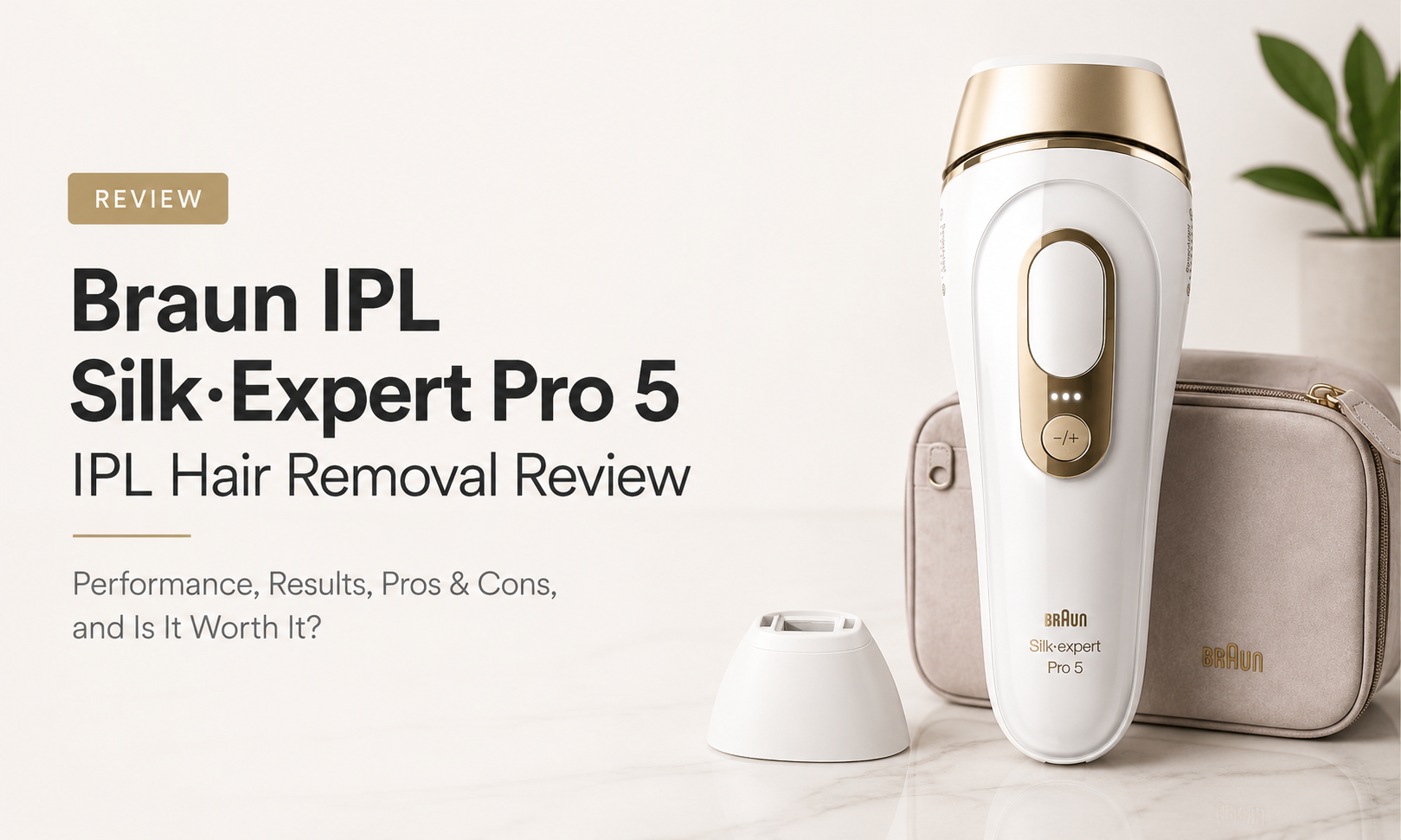
Braun Silk·Expert Pro 5 Review: What the Research Really Says About This Popular At-Home IPL Device
At-home hair removal sounds straightforward until you start looking at what actually determines whether an IPL device will work. Hair color matters. Skin tone matters. Hair-growth cycles matter. Treatment speed matters if you are covering large areas. Comfort matters because a device that hurts too much tends to end up in a drawer. And perhaps most importantly, the word “laser” gets used so loosely that it is easy to expect permanent hair removal from a device that is actually designed for long-term hair reduction.
That is the context in which the Braun Silk·Expert Pro 5 makes sense. The research presents it as a premium consumer IPL device rather than a true diode laser. It uses broad-spectrum light, relies heavily on automatic skin-tone detection, and is designed to make repeated home treatments relatively simple.
After going through the technical information, expert analysis, consumer feedback, weaknesses, long-term ownership considerations, and competitor comparisons, I think the Pro 5 is a very good device for a fairly specific buyer. I would not call it a universal solution, and I would pay particular attention to the limitations before buying it.
Overall rating: ★★★★☆ 4.3/5
A strong choice for the right skin tone and hair type, especially when fast treatment of large areas matters. Its biggest advantages are automatic skin-tone sensing, a lightweight corded design, rapid initial flash speed, and the absence of consumables. Its biggest weaknesses are heat buildup during longer sessions, sensor frustration on curved areas, limited manual control, and important limitations around skin tone, hair color, and facial vellus hair.
Overview
Braun IPL, Silk·Expert Pro 5, IPL Hair Removal


The first thing to understand: this is IPL, not a true laser
The distinction matters because the two technologies are not interchangeable.
The Braun Silk·Expert Pro 5 uses broad-spectrum visible light ranging from approximately 510 nm to 2000 nm. The optical energy is absorbed by melanin in the hair and converted into heat, which travels toward the follicle and produces localized thermal damage during the active growth phase.
A true diode laser, by contrast, uses a much narrower wavelength. The research compares the Braun with the Tria Hair Removal Laser 4X, which uses an 810 nm diode laser. The Braun is therefore better understood as an at-home IPL hair-reduction system rather than a miniature clinical laser.
Worth knowing: The most important expectation to correct is the idea that the Braun will permanently eliminate every hair forever. The research describes the result as long-term hair reduction, with maintenance treatments still required because dormant follicles can become active again.
Who will get the most from the Braun Pro 5?
IPL works by targeting pigment. That immediately creates a fairly narrow sweet spot: relatively light skin combined with naturally dark hair.
The research identifies Fitzpatrick skin types I through IV as the strongest candidates, particularly when the hair is dark and contains substantial eumelanin. It also notes that users with very dark skin may be prevented from using the device because the system detects the higher level of epidermal melanin.
There is a small inconsistency in the supplied research: one FAQ describes the device as effective for Fitzpatrick I-V, while the main buyer-profile section identifies I-IV as the ideal range and says V and VI are unlikely to be suitable. I would use the more conservative I-IV guidance when making a buying decision rather than assuming that a borderline skin tone will be safe or effective.
| Buyer | Expected fit | Why |
|---|---|---|
| Fair to medium skin with dark hair | Excellent | Strong optical contrast gives IPL the conditions it needs to target the hair. |
| Dark body hair on legs or arms | Excellent | Large areas combine well with the device’s fast initial flash rate. |
| Time-poor user | Very good | The Glide mode is designed for rapid coverage. |
| Blonde, red, grey, or white hair | Poor | The research indicates insufficient pigment for the IPL system to work effectively. |
| Very dark skin | Poor | The skin sensors may prevent operation when the skin contains too much competing melanin. |
| Facial peach fuzz | Potentially unsuitable | The research highlights a risk of paradoxical hair growth on certain facial areas. |
That last point deserves considerably more attention than it usually gets in a product review.
The facial-hair warning I would not ignore
The research identifies paradoxical hypertrichosis as one of the most important unexpected findings. In simple terms, applying insufficient IPL energy to fine vellus hair can, in some circumstances, stimulate the follicles rather than producing the desired reduction.
The concern is particularly relevant to fine facial hair around the jawline, neck, and other hormonally active areas. The research identifies people with PCOS and certain genetic backgrounds as potentially higher-risk groups.
Important limitation: I would not buy the Braun Pro 5 specifically to remove fine facial “peach fuzz.” The research treats this as a potentially serious downside, not a minor edge case. The device is much easier to recommend for coarse, dark terminal hair than for fine facial vellus hair.
The research also specifically warns against using the device off-label to treat broken capillaries or rosacea. The fact that professional IPL can be used for some dermatological applications does not mean a consumer hair-removal device should be repurposed for them.
How the Braun’s SensoAdapt system changes the experience
The feature that most strongly defines the Pro 5 is its automatic skin-tone sensing.
The research says the dual optical sensors scan the skin repeatedly and dynamically adjust the output across multiple intensity levels. The practical idea is simple: instead of asking a beginner to manually decide how much energy to use on every part of the body, the device makes that decision automatically.
For a first-time IPL buyer, I see a real advantage here. There is less guesswork. You are not staring at a complicated screen wondering whether you selected the correct energy setting.
| Technology | What it does | Why it matters |
|---|---|---|
| SensoAdapt | Automatically adjusts intensity according to detected skin tone. | Reduces the amount of manual calibration required from the user. |
| Glide mode | Allows continuous flashing while moving across larger areas. | Makes legs, arms, and other large areas considerably faster to treat. |
| Stamp mode | Provides individual flashes for precision treatment. | More practical for smaller or awkward areas. |
| Gentle modes | Reduce treatment intensity. | Can improve comfort, but slower treatment and potentially slower progress are the trade-offs described by the research. |
There is, however, an interesting downside. SensoAdapt is designed to prioritize safety rather than giving an experienced user maximum manual control. The research reports that some users with medium skin tones find the system overly conservative and would prefer the ability to manually force a higher output.
So the same feature that makes the Braun approachable for beginners can frustrate experienced users who want more control.
Where the Pro 5 is genuinely fast — and where that speed disappears
On paper, one of the most attractive characteristics of the Pro 5 is its flash rate. The research gives a flash interval of roughly 0.5 to 0.9 seconds, with up to 125 flashes per minute at lower energy settings.
That matters much more than a flashy specification might suggest. If you are treating an entire leg, shaving a few seconds from each flash can make the difference between a treatment feeling manageable and feeling like a chore.
The research reports that the initial portion of a session can be remarkably fast, with a lower leg potentially treated in under five minutes.
The catch: The headline speed is not necessarily the speed you get throughout a long continuous session.
The Pro 5 relies on passive air cooling through an internal fan rather than active thermoelectric cooling. As the device runs continuously, heat builds up. The research says the firmware can then reduce the flash rate, with intervals increasing substantially once thermal throttling begins.
This is probably the single biggest performance weakness in the entire research file.
A user treating one small area may barely notice it. Someone attempting a long full-body session is much more likely to notice the difference. What begins as a very quick treatment can turn into a stop-and-start process once the wand gets hot.
Why the Braun can feel almost painless for one person and quite painful for another
There is contradictory feedback in the research about comfort. Some users describe the treatment as almost painless, while others compare it to a hot rubber-band snap or describe considerably sharper sensations.
I don’t think those opinions are actually contradictory.
The research links the sensation primarily to hair density, hair thickness, and the amount of melanin absorbing the light. Sparse hair on the forearms can feel like warmth. Dense, coarse hair in areas such as the underarms or bikini line can absorb much more energy at once and produce a much sharper sensation.
| Situation | Likely experience | What I would consider |
|---|---|---|
| Sparse hair on arms/forearms | Warm flash | Standard treatment is likely easier to tolerate. |
| Dense dark hair | Sharper snapping sensation | Comfort settings may become more attractive. |
| Bikini/underarm areas | Potentially quite intense | Lower-intensity modes may help, but treatments can take longer. |
The design is better thought out than the simplicity suggests
One thing I like about the Pro 5’s design is that Braun has avoided making the wand unnecessarily complicated.
The research describes a lightweight, balanced handpiece with the heavier power components located in an external transformer. That makes sense for a corded device: you lose cordless freedom, but you also avoid putting a large battery inside the handheld unit.
The result is a form factor closer to a streamlined electric shaver than a bulky electronic appliance. That matters during long sessions because wrist fatigue is one of those seemingly minor issues that becomes important after several minutes of repetitive treatment.
The controls are equally simple. There is no requirement for a smartphone app or account, and there is no complicated menu system. The primary controls handle activation and intensity limits, while LED indicators communicate what the automatic system is doing.
I think beginners will appreciate this simplicity. Advanced users may feel differently because the device does not give them complete manual control over the output.
The sensor design is smart, but the physical geometry can be annoying
Automatic sensing sounds perfect until you remember that the sensors have to physically contact the skin.
The research says the dual contact sensors need simultaneous contact to unlock the flash. That is easy on broad, relatively flat areas. It becomes much less convenient around knees, ankles, shins, and other contours.
This is one of those weaknesses I would classify as a usability problem rather than a fundamental performance failure.
If most of your treatment involves legs and arms, you will probably learn the correct angle quickly. If you spend a lot of time working around highly contoured areas, the repeated red-light lockouts can become irritating.
Buying tip: Do not judge the Pro 5 only by its maximum flash speed. The physical shape of the treatment area matters. The fastest device on paper is not necessarily the fastest device if you repeatedly have to reposition it to get the sensors to activate.
Setup is refreshingly simple
There is no complicated installation process. The research describes a straightforward setup: connect the transformer to power, connect the wand, attach the appropriate treatment head, and begin.
There is also no mandatory smartphone application or account registration. That may sound unimportant, but it removes a layer of software friction that some modern beauty devices introduce.
The biggest learning curve is not technical. It is learning how to prepare and treat the skin correctly.
The research identifies inadequate shaving as a particularly important beginner mistake. Hair above the surface can absorb the optical energy before it reaches the follicle, creating unpleasant burning, odor, and potentially damaging residue on the treatment window.
In other words, shaving properly is not an optional preparation step. It is part of getting the IPL process right.
What the 400,000-flash rating actually means
Four hundred thousand flashes sounds enormous, and it is.
The research estimates that this could represent decades of full-body treatments for a single user. But I would not interpret that number as meaning the device will necessarily perform identically for decades.
The lamp itself is non-replaceable, and the research notes that other internal components can age over time. It specifically raises the possibility of optical and capacitor degradation, meaning the output could gradually decline even before the theoretical flash limit is reached.
This is an important distinction. The flash count is primarily reassuring because it removes the need to buy replacement cartridges or lamps during normal ownership. It should not be treated as a guarantee that every component will deliver identical performance for 20-plus years.
Maintenance is one of its strongest ownership advantages
There are no conductive gels or replacement lamp cartridges to keep buying. After treatment, the research recommends cleaning the glass treatment area and reflective housing using a dry lint-free cloth or a small amount of isopropyl alcohol as appropriate.
That makes the ownership model refreshingly simple: buy the device, maintain the treatment window, replace nothing routinely, and continue with periodic maintenance treatments as needed.
| Ownership factor | Assessment | Why it matters |
|---|---|---|
| Replacement lamp | Not required | Removes a recurring consumable expense. |
| Conductive gel | Not required | Makes preparation simpler than systems requiring gels. |
| Cleaning | Required | Keeps the treatment window clean and ready for use. |
| Long-term maintenance treatments | Required | Hair reduction should not be confused with permanent eradication. |
| Repairability | Limited | The research describes the device as effectively non-repairable by consumers if major internal components fail. |
The long-term result is not “hair-free forever”
This is another area where expectations need to be realistic.
The research describes an intensive treatment phase followed by ongoing maintenance. It reports that users who follow the recommended schedule consistently can achieve substantial visible hair reduction, but it also emphasizes that dormant follicles can become active again.
That means the Pro 5 is better viewed as a long-term hair-management system.
You may eventually reach the point where shaving becomes much less frequent, but stopping treatment completely does not necessarily mean the result will remain unchanged forever.
| Stage | What matters | Realistic interpretation |
|---|---|---|
| Initial treatment | Consistency | IPL only affects follicles in the appropriate stage of the hair-growth cycle. |
| Visible reduction | Repeated treatments | Hair can become less dense and less noticeable over time. |
| Maintenance | Periodic touch-ups | Some treatment remains necessary to maintain the reduction. |
The marketing claim I’d treat carefully
The research notes that manufacturer messaging around visible results in two or three weeks or around one month is more aggressive than the timeline suggested by dermatological and clinical perspectives included in the research.
The alternative expectation is considerably more conservative: consistent treatment over roughly 8 to 12 weeks before judging whether the device is fundamentally working for you.
I think that is the more useful way to approach the purchase.
If you see meaningful reduction earlier, great. But buying the device expecting dramatic transformation after a couple of sessions sets you up for disappointment because hair does not grow according to a simple on/off schedule.
Realistic expectation: The most important variable is not how impressive the device looks on paper. It is whether your skin and hair combination is appropriate for IPL and whether you are willing to follow the treatment schedule consistently.
Why some users love it while others become frustrated
The consumer feedback summarized in the research is surprisingly consistent once the different use cases are separated.
| Positive experience | Negative experience | Underlying reason |
|---|---|---|
| “It barely hurts.” | “It feels painful.” | Hair density, hair thickness, and pigmentation differ substantially between treatment areas. |
| “My legs improved quickly.” | “It barely worked on my bikini area.” | Hair characteristics and growth cycles vary by body area. |
| “It is incredibly fast.” | “It slows down halfway through.” | Thermal throttling becomes more relevant during longer continuous sessions. |
| “The automatic sensing is great.” | “I wish I could control the power.” | Beginners benefit from automation while experienced users may want more manual control. |
Braun Silk·Expert Pro 5 ratings
| Category | Rating | Why |
|---|---|---|
| Effectiveness | ★★★★★ 5.0/5 |
Very strong potential for appropriate skin/hair combinations, especially dark terminal hair. |
| Performance | ★★★★½ 4.5/5 |
Very fast initial flashing, with thermal slowdown preventing a higher score. |
| Ease of use | ★★★★½ 4.5/5 |
Simple controls and automatic skin-tone adjustment make it approachable. |
| Comfort | ★★★★☆ 4.0/5 |
Comfort varies significantly with hair density and treatment area. |
| Design & ergonomics | ★★★★½ 4.5/5 |
Lightweight balanced wand and simple controls are major strengths. |
| Safety system | ★★★★★ 5.0/5 |
The automatic skin-tone sensing and contact requirements are central strengths in the research. |
| Maintenance | ★★★★★ 5.0/5 |
No replacement lamps or conductive gels are required. |
| Reliability | ★★★★☆ 4.0/5 |
The research describes generally strong reliability but notes sensor failures and limited repairability. |
| Value | ★★★★☆ 4.0/5 |
Strong long-term ownership proposition, although the initial premium price and regional import costs matter. |
Braun Silk·Expert Pro 5: product at a glance
| Product detail | Research finding | What it means |
|---|---|---|
| Technology | Broad-spectrum IPL | Designed for long-term hair reduction rather than true laser hair removal. |
| Maximum fluence | Up to 6 J/cm² | Strong for home IPL, but substantially below the energy range cited for clinical lasers. |
| Flash capacity | 400,000 flashes | Designed to last through extremely long-term personal use without replacement cartridges. |
| Flash speed | Approximately 0.5–0.9 seconds | Makes large-area treatment relatively quick, especially early in a session. |
| Skin sensing | SensoAdapt | Automatically adjusts output instead of relying entirely on manual selection. |
| Power | Corded, 100–240 V | No battery charging, but you must remain near a power outlet. |
| Treatment modes | Stamp and Glide, with Gentle options | Supports both precision treatment and rapid coverage. |
| Maintenance | Clean treatment window after use | No routine consumable replacement is required. |
What about the different Pro 5 model numbers?
The research points out that consumers can encounter model numbers such as PL5124, PL5137, PL5157, and PL5347. The important point is that these variants are described as sharing the same core Pro 5 hardware and technology, while packaging, trim, storage case, and included attachments differ.
| Variant | Research description | Best reason to choose it |
|---|---|---|
| PL5124 | Standard and precision heads, pouch and razor. | Basic full-body and facial use. |
| PL5137 / PL5157 | Standard and precision heads with premium storage options. | Standard full-body treatment. |
| PL5347 | Standard, wide, and two precision heads plus vanity case and razor. | Maximum versatility for large areas and contours. |
How the Braun compares with major alternatives
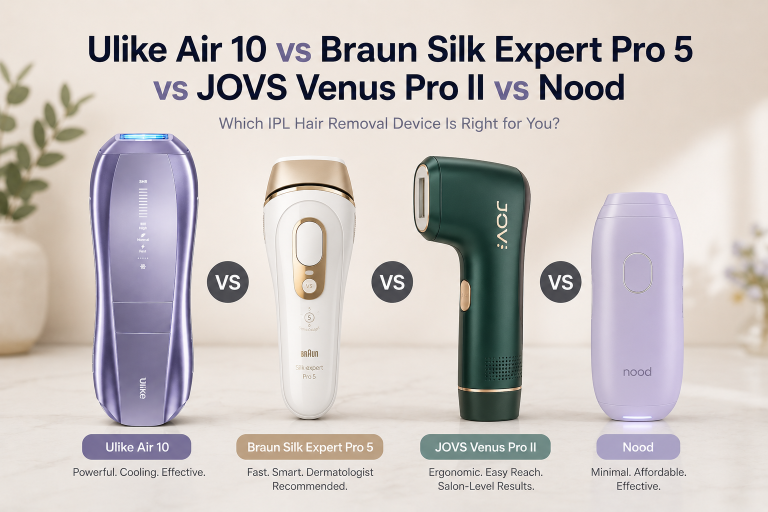
The research identifies three particularly useful comparison points: Ulike, Philips Lumea, and Tria.
| Device | Main difference | Where it has an advantage | Trade-off |
|---|---|---|---|
| Braun Pro 5 | Automatic skin sensing and rapid corded IPL. | Safety automation, ergonomics, large-area convenience. | Thermal throttling and no full manual power control. |
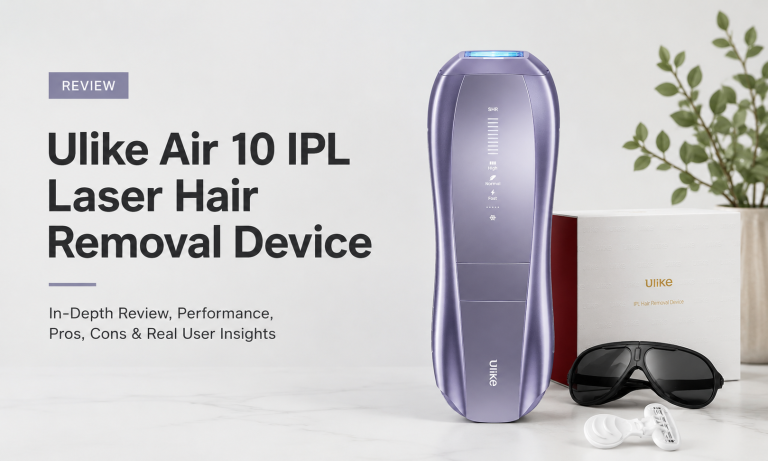
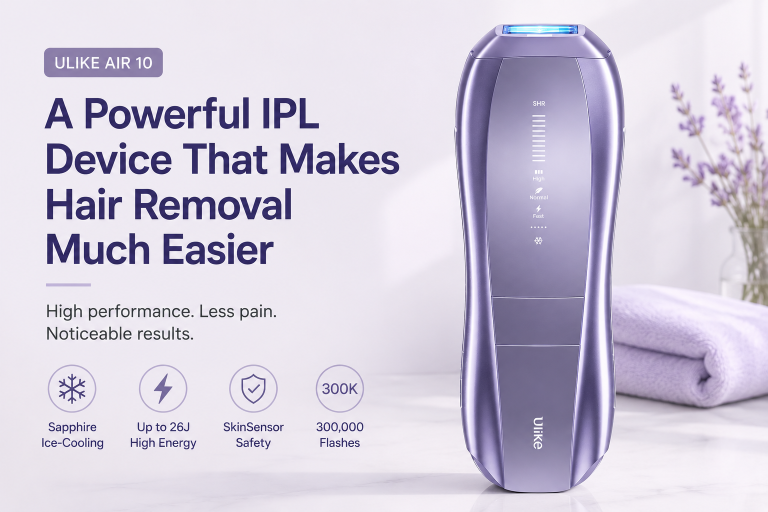
| Ulike Air 3 / Air 10 | Active Peltier cooling. | Comfort and sustained treatment speed. | The research positions Braun as stronger for its safety-oriented automation and brand pedigree. |
| Philips Lumea 9000 | Cordless operation and curved heads. | Maneuverability and anatomical fit. | Greater weight from the internal battery. |
| Tria Hair Removal Laser 4X | True 810 nm diode laser. | Higher stated energy and small-area treatment. | Much slower full-body treatment and substantially more discomfort. |
If comfort is the deciding factor, the research gives Ulike’s active cooling a meaningful advantage. If cordless convenience is more important, Philips Lumea becomes interesting. If maximum optical energy on small stubborn areas is the priority, the Tria’s diode-laser approach is fundamentally different.
For broad full-body use, however, the Braun’s lightweight corded design and rapid initial flash rate remain compelling.
Pros and cons
| Pros | Cons |
|---|---|
| Excellent automatic skin-tone sensing | Thermal throttling during longer continuous sessions |
| Very fast initial flash rate | Sensor contact can be frustrating around knees and ankles |
| Lightweight, balanced handheld design | No full manual control over output |
| No replacement lamps or conductive gels | Corded rather than cordless |
| Simple setup without mandatory app or account | Not suitable for every skin tone or hair color |
| Strong choice for large treatment areas | Facial vellus hair carries an important risk highlighted by the research |
| Large 400,000-flash capacity | Long-term repairability is limited |
Who should buy the Braun Pro 5?
I would put the strongest candidate into a fairly specific category: someone with relatively light-to-medium skin and naturally dark terminal hair who wants to reduce body hair at home without dealing with gels, replacement cartridges, complicated controls, or a heavy cordless wand.
The Pro 5 particularly makes sense for someone treating large areas such as legs and arms. The combination of automatic sensing, Glide mode, fast initial flashes, and lightweight ergonomics addresses the biggest practical problem with at-home hair removal: actually sticking with the routine.
Who should probably look elsewhere?
| If you are… | I’d reconsider because… |
|---|---|
| Looking to treat blonde, red, grey, or white hair | The research indicates the device requires sufficient dark pigment. |
| Very dark-skinned | The device may lock out rather than provide a usable treatment. |
| Want to remove facial peach fuzz | The research identifies paradoxical hypertrichosis as a potentially serious concern. |
| Want completely permanent hair removal | The device requires ongoing maintenance. |
| Need completely painless treatment | Dense dark hair can produce a significant snapping sensation. |
| Want maximum manual control | SensoAdapt deliberately automates much of the power selection. |
| Want a fast full-body session without pauses | Thermal throttling can reduce the flash rate during extended use. |
Important safety and limitation notes
The supplied research describes the Pro 5 as FDA 510(k) cleared for over-the-counter aesthetic hair removal and notes Skin Health Alliance accreditation. It also describes UV filtering and automatic skin-tone sensing as important safety mechanisms.
Those features should not be interpreted as making IPL risk-free. The research itself identifies situations where the device should not be used or where extra caution is warranted, particularly inappropriate skin tones, unsuitable hair colors, facial vellus hair, and off-label treatment of vascular skin conditions.
The intense flash is also visually bright. The research says the contact mechanism is designed to prevent the device from firing without appropriate skin contact, but users may still find the flash uncomfortable to look at.
Safety note: This review is based on the supplied research rather than a medical assessment. Users should follow the manufacturer’s instructions and should not assume that a consumer IPL device is appropriate for every skin condition or treatment area.
Questions I would ask before buying
Does it work on my skin tone and hair color?
The research says the strongest candidates have fair-to-medium skin and dark hair. Blonde, red, grey, and white hair are identified as unsuitable because they lack the required pigment. The research also warns that very dark skin can trigger the device’s safety lockout.
Does the Braun Pro 5 require a voltage converter in Jordan?
According to the supplied research, no. Its 100–240 V power supply is compatible with the local voltage range. A physical plug adapter may be needed depending on the plug configuration.
Does it need replacement lamps or cartridges?
No routine replacement lamp or conductive gel is required according to the research. The quartz lamp is rated for 400,000 flashes.
Does IPL treatment hurt?
It depends heavily on the treatment area and hair density. Sparse hair may feel like warmth, while dense coarse hair can produce a sharp snapping sensation. Gentle modes can reduce intensity at the cost of slower treatment.
Can women use it on the face?
The research says women can use it on appropriate coarse, dark terminal hair around areas such as the upper lip and chin, but specifically warns against treating fine peach fuzz because of the risk of paradoxical hypertrichosis.
Can men use it on facial beard hair?
The supplied research recommends against it because of the extreme density of facial beard hair and the associated burn risk.
Is the bright flash dangerous to the eyes?
The research describes the contact system and UV filtering as safety features and notes FDA clearance. The flash is nevertheless extremely bright, so following the manufacturer’s instructions and avoiding off-label use around the eyes is important.
What the research still doesn’t tell us
One reason I would not give the Pro 5 a perfect score is that even an extensive research file has unanswered questions.
| Information gap | Why it matters |
|---|---|
| Long-term optical degradation curve | The research does not establish exactly how much output changes over hundreds of thousands of flashes. |
| Exact output at every SensoAdapt level | It makes precise comparisons between automatic intensity levels and competitors difficult. |
| Detailed demographic efficacy | There is limited granular evidence for specific populations and difficult hormonal hair types. |
These gaps do not make the device a bad purchase. They simply mean that some of the impressive long-term claims should be treated as estimates rather than guarantees.
The biggest strength and the biggest weakness
Biggest strength
The combination of SensoAdapt automation, rapid initial flashing, and a lightweight wand makes the Braun unusually easy to approach for someone who does not want to become an expert in IPL settings.
Biggest weakness
Thermal throttling undermines one of its most attractive advantages. The device starts fast, but extended Glide use can force the user to slow down or pause while the hardware cools.
My buying decision
If I were choosing an at-home IPL device based solely on this research, I would put the Braun Silk·Expert Pro 5 on my shortlist rather than dismissing it because of its limitations.
The reason is that most of its strongest characteristics are practical rather than gimmicky. Automatic skin-tone sensing reduces guesswork. The wand is lightweight. Large areas can be treated quickly when the device is cool. There are no recurring cartridges or conductive gels. The controls are simple. And the safety system is central to the design rather than being an afterthought.
But I would only buy it after confirming that my skin tone and hair color fall into the appropriate range. I would also be realistic about the treatment schedule and understand that this is hair reduction, not absolute permanent removal.
The biggest reason I would hesitate is if comfort were my top priority. The research gives Ulike’s active cooling a clear advantage in that area. I would also hesitate if I were primarily interested in facial peach fuzz, because the paradoxical-hair-growth warning is too significant to ignore.
For large areas of dark body hair on suitable skin, however, the Braun’s overall combination of speed, automation, ergonomics, and low-maintenance ownership is compelling.
Final verdict: is the Braun Silk·Expert Pro 5 worth buying?
The Braun Silk·Expert Pro 5 is not the perfect IPL device, but the research suggests it is a very capable one.
Its biggest selling point isn’t simply the maximum energy or the 400,000-flash figure. It is the way several practical decisions work together: automatic skin sensing, fast initial flashing, a balanced corded wand, straightforward controls, and no recurring consumables.
The biggest problem is equally practical. Once the device heats up during a longer session, the performance advantage starts to fade. The contact sensors can also become frustrating on curved areas, and experienced users may dislike the lack of complete manual control.
Most importantly, this is a product that rewards the right buyer. Someone with suitable skin and dark terminal hair who wants to reduce body hair over the long term could get a lot from it. Someone with unsuitable hair color, very dark skin, or an expectation of completely permanent hair removal is likely to be disappointed.
And I would be particularly cautious about facial vellus hair. That is the one part of the research that would materially change my recommendation for a potential buyer.
My overall rating
★★★★☆
4.3/5
A very strong at-home IPL option for the right buyer, with excellent automation and large-area usability, but meaningful limitations around heat management, sensor geometry, skin/hair compatibility, and facial vellus hair.
This review is based on the supplied research material, including technical analysis, expert commentary, competitor comparisons, and summarized consumer feedback. Claims and recommendations above are presented within the scope of that research.