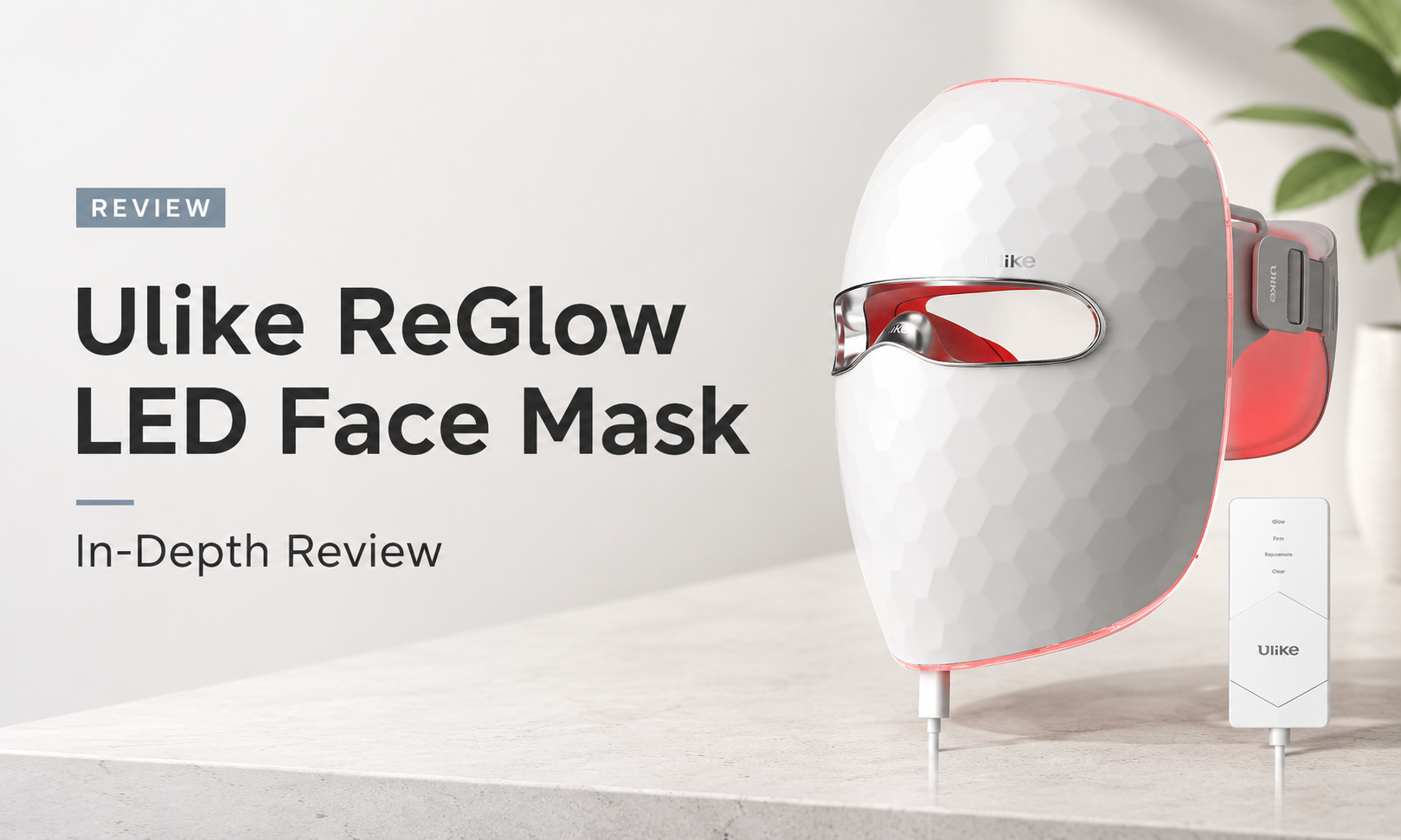
Ulike ReGlow LED Face Mask Review: Powerful Light Therapy With Some Important Trade-Offs
LED face masks have become much easier to buy, but choosing one is not as simple as picking the mask with the most LEDs or the highest output number. The useful questions are whether the wavelengths make sense for your skin concerns, whether the treatment is practical enough to use consistently, whether the mask actually fits comfortably, and whether its design creates problems that become frustrating after the initial excitement wears off.
That is what makes the Ulike ReGlow interesting. Its appeal is not just that it is a premium LED mask. It combines four wavelengths, 272 LEDs, integrated eye protection, a rigid high-output design, and treatment cycles as short as five minutes. The result is a device that appears particularly well suited to people trying to address several concerns at once, including acne, redness, and visible signs of aging.
But the same engineering decisions that make the ReGlow powerful also create some of its biggest weaknesses. The hard-shell construction can be uncomfortable for certain face shapes, the mask is bulky, the battery system requires planning, and the proprietary controller connection is a particularly important long-term concern.
My quick take: The Ulike ReGlow is most compelling if I wanted a high-output LED mask that could address multiple skin concerns without requiring a long treatment session. The four-wavelength system and five-to-eight-minute treatment windows are genuinely useful advantages. I would hesitate, however, if physical comfort, portability, or long-term hardware simplicity were my highest priorities.
My Overall Rating
★★★★☆ 4.2/5
I think the ReGlow earns a strong rating because its core proposition is unusually convincing: a versatile wavelength combination delivered at high irradiance in a very short treatment window. The research also points to meaningful user satisfaction with acne reduction, brightness, plumpness, and overall skin appearance.
The rating stops short of the highest tier because the physical design is not universally comfortable and the ownership experience has some concerns that are difficult to ignore. In particular, the proprietary controller and cord represent a potentially serious failure point, while the battery and rigid-shell design add everyday friction.
Ulike ReGlow at a Glance
Ulike ReGlow LED Face Mask


| Category | Research Finding | Why It Matters |
|---|---|---|
| Technology | Four-wavelength LED photobiomodulation | Allows the mask to target acne, redness, and signs of aging rather than concentrating on one concern. |
| LEDs | 272 LEDs | The high-density array is designed to provide broad, consistent facial coverage. |
| Wavelengths | 465 nm, 590 nm, 630 nm, 830 nm | The unusual yellow-light inclusion gives the ReGlow a broader purpose than many red/NIR-only masks. |
| Treatment time | 5 to 8 minutes | Short sessions can make consistent use considerably easier. |
| Irradiance | Up to 100 mW/cm² | High output helps explain the short treatment windows, although maximum output should not automatically be interpreted as everyday performance. |
| Construction | Rigid hard-shell polymer | Creates a stable optical structure but makes the mask heavier and less adaptable to different face shapes. |
| Weight | 404 grams with straps | Weight distribution and strap adjustment become important for comfort. |
| Battery | 3.7V, 2600 mAh detachable controller | Cordless operation is convenient, but charging becomes part of the ownership routine. |
| Warranty | 2-year limited warranty | Provides meaningful protection, although reported controller-replacement experiences vary. |
What Actually Matters When Buying an LED Face Mask?
LED masks can look remarkably similar from the outside, but the underlying buying decision is much more complicated than appearance. The wavelength combination matters because different wavelengths are intended to interact with skin in different ways. Treatment dose matters because a device needs to deliver an appropriate amount of light energy. Coverage matters because uneven exposure can make a theoretically impressive device less useful in practice.
Then there is the factor that is often overlooked: consistency. An LED mask cannot do much for someone who buys an impressive device and then stops using it because sessions are too long, the mask is uncomfortable, or the routine is inconvenient.
That is why the ReGlow’s five-to-eight-minute treatment schedule is more important than it might initially appear. A shorter treatment is not automatically a better treatment, but a treatment that is easier to fit into everyday life has a practical advantage because adherence becomes easier.
The ReGlow also takes a broader approach than a simple red-light mask. Its combination of blue, yellow, red, and near-infrared wavelengths is designed to address different concerns within the same device.
How the Ulike ReGlow Works
The ReGlow uses photobiomodulation, with 272 LEDs divided among four wavelengths. Each wavelength has a different intended role.
| Wavelength | Primary Purpose | Why It Matters |
|---|---|---|
| 465 nm blue | Acne-related treatment | Targets Cutibacterium acnes through light-sensitive porphyrins, making it the wavelength most directly relevant to active breakouts. |
| 590 nm yellow | Redness and pigmentation-related concerns | This is one of the ReGlow’s most unusual features and gives it a role beyond conventional red/blue LED masks. |
| 630 nm red | Skin rejuvenation | The research associates red light with fibroblast activity, collagen production, and improvement in fine lines and overall skin appearance. |
| 830 nm NIR | Deeper tissue photobiomodulation | Near-infrared light penetrates more deeply and is associated with cellular energy production and tissue repair mechanisms. |
The most interesting wavelength here is arguably the 590 nm yellow light. Red and blue LEDs are common in consumer devices, whereas yellow light gives the ReGlow a more differentiated purpose. The research specifically highlights its potential relevance to erythema, redness, vascular activity, and pigmentation-related concerns.
What stood out to me: I would not buy the ReGlow simply because it has 272 LEDs. The more meaningful differentiator is the combination of four wavelengths, particularly the inclusion of 590 nm yellow light. That makes the device more interesting for someone whose skin concerns extend beyond either acne or fine lines alone.
What the High Irradiance Actually Means
The ReGlow is rated at up to 100 mW/cm², which is a substantial output figure and helps explain the short five-to-eight-minute treatment windows. But this is exactly the kind of specification that needs interpretation rather than celebration.
High irradiance is useful because it allows the device to deliver a meaningful dose in a shorter period. The research specifically identifies the Firm mode as delivering approximately 19.2 J/cm² over eight minutes at its stated 40 mW/cm² output. That is considerably more useful information than simply saying the mask is “powerful.”
For me, the practical benefit is time. If I had to choose between a device that required a lengthy daily session and one that could fit into a short routine while delivering an appropriate treatment dose, I would take the shorter option seriously.
However, maximum irradiance is not the same thing as guaranteed results. Biological responses still depend on the treatment mode, consistency, individual skin characteristics, and the concern being addressed. A high number on the specification sheet should therefore be viewed as part of the treatment system rather than as a guarantee of superior results.
The 360° Bio-Mirror Is More Than a Cosmetic Detail
Ulike’s internal 360° Bio-Mirror is designed to reflect scattered photons back toward the skin. According to the research, the manufacturer claims that this increases overall light energy irradiance by 77.4% compared with direct exposure from a matte interior design.
The important buyer question is not whether “77.4%” sounds impressive. It is whether the optical design helps provide more consistent exposure across the contours of the face.
That is the more meaningful interpretation. A dense LED array only helps if the delivered light reaches the intended areas effectively. The mirror system is therefore part of the ReGlow’s attempt to make the rigid form factor an optical advantage rather than simply a physical inconvenience.
The Strongest Reason I Would Buy the ReGlow
For me, the central buying argument is versatility combined with speed.
Many LED masks are built around a narrower purpose. The ReGlow instead gives the buyer blue light for acne, yellow light for redness-related concerns, red light for rejuvenation, and NIR for deeper photobiomodulation. It then packages those capabilities into treatment modes that take only five or eight minutes.
That combination matters most to someone who has multiple concerns. If my only goal were basic anti-aging treatment and comfort were my highest priority, I would not automatically choose the ReGlow. But if I wanted one device that could address breakouts while also fitting an anti-aging routine, its versatility would make much more sense.
Real-World Performance: What Should You Actually Expect?
The research suggests that acne-related changes are generally noticed sooner than the longer-term rejuvenation effects. The Clear mode is reported to produce noticeable suppression of emerging acne lesions and inflammation relatively quickly, with user reports describing changes within the first couple of weeks of consistent use.
Anti-aging results require more patience. The processes associated with collagen production and changes in skin texture do not happen overnight. The research places more noticeable improvements in areas such as fine lines, elasticity, texture, and plumpness in the roughly four-to-eight-week range when use is consistent.
| Goal | Expected Timeline in the Research | Buying Implication |
|---|---|---|
| Acne and emerging breakouts | Some users report changes within the first two weeks. | The device may be particularly attractive if acne is an immediate priority. |
| Skin brightness and plumpness | Commonly reported as a longer-term improvement. | Consistency matters more than expecting a dramatic overnight transformation. |
| Fine lines and texture | Roughly four to eight weeks for noticeable changes. | This is a maintenance-oriented routine, not a one-session treatment. |
| Overall skin improvement | Gradual with continued use. | Buyers need to be comfortable with ongoing treatment rather than a permanent one-time result. |
Realistic expectation: I would think of the ReGlow as a maintenance tool rather than a permanent solution. The research indicates that benefits can regress when treatment is abandoned for several weeks. That makes consistency a much more important factor than simply owning a high-output mask.
The Marketing Claims I Would Treat Carefully
The ReGlow’s technical specifications are impressive, but the best way to interpret them is to separate engineering capability from biological outcomes.
| Claim or Feature | What It Really Means for the Buyer |
|---|---|
| Up to 100 mW/cm² | The high output helps explain the short treatment times, but the maximum number should not be treated as a guarantee of better results. |
| 272 LEDs | High LED density is useful for coverage, but LED count alone does not determine treatment quality. |
| 77.4% greater irradiance from Bio-Mirror technology | The practical value is more consistent use of scattered light across facial contours, rather than simply having a bigger number. |
| Five-to-eight-minute treatments | This is one of the most meaningful real-world advantages because shorter sessions can make regular use easier. |
| Four wavelengths | The broader spectrum makes the ReGlow more versatile, especially for users dealing with several concerns simultaneously. |
Why Some Users Love the Comfort and Others Don’t
This is one of the clearest contradictions in the research, and I don’t think it should simply be dismissed as inconsistent reviewing.
Some users describe the padded woven strap and silicone eye seals as surprisingly comfortable and well balanced. Others report significant pressure around the nose, eyes, and orbital bones. The explanation appears to be the rigid shell itself.
A flexible silicone mask can adapt to different facial structures. The ReGlow cannot do that to the same degree. It is engineered around a fixed geometry and uses the strap and silicone seals to position that geometry over the face.
If your facial structure happens to work well with the mask, the rigidity can feel secure rather than problematic. If it does not, the same rigidity becomes the source of pressure points and red marks.
That makes comfort a particularly personal consideration here. I would not assume that a positive comfort review means the mask will fit everyone equally well.
The Missing Mouth Opening Is a Small Design Decision With Real Consequences
The absence of a mouth aperture is another unusual aspect of the design. The lower portion of the mask remains enclosed, which can trap warm exhaled air and produce condensation.
For many users, this will probably be nothing more than a minor annoyance. For someone prone to claustrophobia, however, it could be much more important. The research specifically identifies mild feelings of confinement and respiratory discomfort among the potential drawbacks.
This is a good example of why a specification sheet cannot tell the whole story. “No mouth opening” sounds like a minor design detail until you imagine wearing a rigid mask over your entire face for several minutes.
Setup Is Easy, But There Is One Important Skincare Mistake to Avoid
There is very little hardware setup involved. The straps arrive attached, and the main assembly involves connecting the mask to its battery controller.
The more important learning curve concerns what you put on your skin before treatment.
The research emphasizes that the mask should be used on clean, dry skin. Applying thick moisturizers, oils, SPF products, or certain active ingredients beforehand can interfere with light exposure and may increase the risk of unwanted reactions.
This is particularly important because it is easy to assume that an LED mask should be used after applying an expensive serum so that the light can somehow push the ingredients deeper into the skin. The research specifically identifies that assumption as a common mistake.
For the routine described in the research, light therapy comes first and skincare products are applied afterward.
Important: Use the mask according to the manufacturer’s instructions and the safety information applicable to your situation. The research identifies restrictions and cautions for certain users, including people with photosensitivity, people taking photosensitizing medications, pregnant users, and people with certain medical conditions. Skin conditions and treatment suitability should be discussed with a qualified dermatologist when appropriate.
The Battery Is Convenient Until You Become a Heavy User
The detachable 2600 mAh battery controller gives the ReGlow an important advantage: you are not physically attached to a wall outlet during treatment.
That makes the mask easier to incorporate into normal life. The research suggests users can move around, watch television, use a phone, or perform light tasks while the treatment runs.
The downside is battery management. The reported operating time is approximately 40 minutes per charge, followed by roughly three hours of charging. Because the mask cannot operate while the controller is charging, forgetting to charge it can interrupt your routine completely.
The simple indicator is another small annoyance. Instead of showing a precise remaining percentage, the controller uses a basic LED warning system. Research feedback suggests that some users find the warning comes too late.
For someone using one five-minute treatment at a time, this may be perfectly manageable. Someone stacking multiple modes can drain the battery much faster.
Design and Build Quality: Premium, But Not Practical in Every Home
The hard-shell construction gives the ReGlow a more substantial feel than a soft silicone mask. It also provides a stable platform for the LEDs and reflective interior.
But the 404-gram weight and rigid shape make storage a genuine consideration. A flexible mask can be flattened and placed in a drawer. The ReGlow occupies a much larger three-dimensional space and essentially requires dedicated countertop or shelf room.
That matters more than it sounds. Devices that are easy to store and retrieve tend to be easier to use consistently. If the mask has to be carefully placed somewhere every time, portability and storage become part of the overall usability equation.
I would therefore consider the ReGlow more of a dedicated home skincare device than a travel-friendly accessory.
What People Who Used the Product Say
The available user feedback is overwhelmingly positive about the basic treatment concept, but the praise is not universal and the negative feedback tends to focus on physical and ownership issues rather than the fundamental idea of LED therapy.
What Positive Users Consistently Praise
- Very short five-to-eight-minute treatment sessions.
- Visible improvement in acne and emerging blemishes.
- Improved brightness, plumpness, and texture over longer periods.
- The ability to address multiple concerns with different modes.
- Built-in eye protection.
- A simple controller without mandatory smartphone pairing or an app.
- Cordless operation during treatment.
What More Critical Users Complain About
- Pressure around the eyes or nose caused by the rigid shell.
- Goggle marks after treatment.
- Battery life and the lengthy charging period.
- The lack of a precise battery percentage.
- Bulkier storage than flexible masks.
- Heat and condensation during treatment.
- Concerns about the proprietary cord and controller connection.
Importantly, the research does not establish an exact statistical failure rate for the controller cord. That means the reported failures should be treated as a recurring concern rather than proof that every unit will eventually fail.
The Proprietary Cord Is the Weakness I Take Most Seriously
Hardware reliability is normally less exciting than wavelengths or LED counts, but it may matter more over several years.
The research identifies the tethered cord between the mask and controller as a recurring failure point. Repeated bending, tugging, and wrapping can stress the connection. If the cord develops an internal failure, the proprietary controller system can make the entire device effectively unusable.
This is especially concerning because there is limited information about long-term replacement costs and exact failure rates.
The two-year warranty provides some protection, but reported customer-service experiences are mixed. Some users describe smooth replacements, while others report disputes over whether cord damage qualifies for warranty coverage.
Limitation worth knowing: The research identifies the controller cord as a potentially serious ownership vulnerability, but it does not establish the actual percentage of units that fail. I would treat this as a meaningful risk factor rather than assume that failure is inevitable.
Heat Is Normal, But It May Surprise You
LED therapy is often mentally categorized as a completely cool treatment, so the amount of warmth generated by the ReGlow can come as a surprise.
The high-density LED array and reflective interior can create noticeable ambient heat during treatment. This becomes more apparent when users stack multiple modes.
The research describes the heat as a normal response rather than evidence of dangerous thermal damage when the device is used as directed. Still, people who expect a completely cool experience should know what to expect.
One of the Most Interesting Findings: Yellow Light
If I were researching this mask specifically to understand what separates it from the crowded LED-mask market, I would spend more time looking at the 590 nm yellow light than at the headline LED count.
The research highlights scientific evidence surrounding yellow light and its relationship to vascular activity, inflammation, erythema, pigmentation-related pathways, and skin-barrier considerations. That gives the ReGlow a potentially useful niche for people whose concerns include persistent redness or post-inflammatory erythema alongside acne and aging.
This is also why the ReGlow makes more sense as a multi-concern device than a basic anti-aging mask. It is trying to solve several different problems through different wavelengths rather than asking one wavelength to do everything.
Blue Light and Darker Skin Tones Deserve Extra Attention
The research raises an important caution regarding blue-light use and hyperpigmentation in darker skin phototypes. While blue light is included for acne-related treatment, the research notes that excessive exposure may contribute to temporary hyperpigmentation in some people with Fitzpatrick IV-VI skin types.
I would therefore avoid interpreting the presence of blue light as a reason to use the Clear mode more frequently than recommended. More treatment is not automatically better, and this is an area where individual skin characteristics matter.
Anyone with a history of photosensitivity, pigmentation problems, or a condition that makes light-based treatments questionable should discuss the device with a dermatologist before use.
Long-Term Ownership: What We Know and What We Don’t
The longer-term picture is mixed.
On the positive side, the polymer shell, silicone components, and LED system are described in the research as durable. There are no consumable cartridges or recurring treatment components that need routine replacement.
The bigger uncertainty is the battery and controller system. Heavy users can recharge the battery frequently, yet the research does not provide reliable multi-year battery degradation data. It also does not establish how readily replacement controllers can be purchased outside the warranty period.
That uncertainty matters because the ReGlow is a relatively expensive device. A premium purchase should ideally have a clear path for keeping the product operational for many years.
| Area | What the Research Supports |
|---|---|
| Warranty | Two-year limited manufacturer warranty. |
| Consumables | No consumable treatment components are required. |
| Battery longevity | Long-term degradation data beyond the available ownership period is limited. |
| Controller replacement | The research does not establish an easy, standardized out-of-warranty replacement path. |
| Cord reliability | Recurring user complaints exist, but the actual statistical failure rate is unknown. |
Maintenance Is Simple, But You Need to Be Careful
The cleaning routine is straightforward: the research says Ulike recommends a soft, slightly damp cloth.
However, the Bio-Mirror surface creates an unusual maintenance restriction. The manufacturer specifically prohibits alcohol, thinner, gasoline, nail-polish remover, and strong chemical solvents because they can damage the reflective surface.
The mask is also not water-resistant and should not be submerged or used in a shower.
Because the mask sits directly against the face and can accumulate sweat, oil, and condensation, regular cleaning is particularly important. This is not an appliance I would treat casually just because it is an electronic skincare product.
Ulike ReGlow vs. the Major Alternatives
The research provides useful comparisons with Omnilux Contour, Dr. Dennis Gross SpectraLite, and TheraFace Mask. There is no universal winner because the products emphasize different priorities.
| Product | What Makes It Attractive | Main Trade-Off | Best Fit |
|---|---|---|---|
| Ulike ReGlow | Four wavelengths, high LED density, fast sessions, integrated eye protection. | Rigid fit, bulk, battery management, proprietary cord concern. | People with multiple skin concerns who prioritize speed and versatility. |
| Omnilux Contour | Flexible medical silicone and strong physical comfort. | Less versatile wavelength selection and a longer treatment period. | Users who prioritize comfort, flexibility, and travel. |
| Dr. Dennis Gross SpectraLite | Extremely short three-minute treatment time. | Lower LED density and less wavelength versatility than the ReGlow. | Buyers who place maximum value on treatment speed. |
| TheraFace Mask | Large LED count plus vibration therapy. | Heavy design and premium pricing. | Users interested in combining light therapy with additional facial treatment features. |
If Comfort Is Your Priority, I Would Look Elsewhere
The ReGlow makes the most sense when optical performance and treatment versatility matter more to you than having the softest possible mask.
If I were buying primarily for anti-aging and wanted something that conformed closely to my face, the flexible construction of the Omnilux Contour would be more appealing based on the research available here.
That does not make the ReGlow inferior. It simply means the products are solving different problems.
If Speed Is Your Priority, the ReGlow Is Very Competitive
The five-to-eight-minute treatment window is one of the ReGlow’s strongest practical advantages. The Dr. Dennis Gross SpectraLite is even faster according to the supplied comparison, but the ReGlow offers a broader wavelength profile and higher LED count.
So the question becomes whether I want the absolute shortest possible treatment or a short treatment combined with greater versatility.
For a buyer managing several concerns, I would lean toward the ReGlow’s broader approach.
Pros and Cons
| Pros | Cons |
|---|---|
| Five-to-eight-minute treatment sessions | Rigid shell can create pressure points |
| Four useful wavelengths | 404-gram weight makes it relatively heavy |
| 272-LED high-density array | Bulky storage footprint |
| Rare 590 nm yellow-light inclusion | Battery requires roughly three hours to recharge |
| Integrated eye protection | Cannot be used while the controller is charging |
| Simple controller with no mandatory app | No precise battery percentage indicator |
| Cordless during treatment | Proprietary cord is a reported failure concern |
| Useful for multiple skin concerns | Enclosed design can create heat and condensation |
Who Should Buy the Ulike ReGlow?
- People dealing with multiple skin concerns: The four-wavelength design makes the most sense when acne, redness, and signs of aging are all relevant.
- Busy users: The five-to-eight-minute treatment schedule removes one of the biggest practical barriers to regular LED therapy.
- Users who dislike complicated technology: The device does not require Bluetooth pairing, firmware updates, or a mandatory smartphone application.
- People interested in yellow light: The 590 nm wavelength gives the ReGlow a particularly interesting role for redness and erythema-related concerns.
- Users who want built-in eye protection: The integrated silicone eye seals remove the need for separate blackout eyewear.
- Dedicated skincare enthusiasts: The device makes more sense for someone willing to maintain a consistent treatment routine rather than someone expecting a one-time fix.
Who Should Avoid It?
- People who prioritize maximum physical comfort: A flexible silicone mask may be a better choice if rigid pressure points are a concern.
- Frequent travelers: The hard-shell construction and large storage footprint make the ReGlow inconvenient to pack.
- People with claustrophobia: The enclosed lower mask and deep eye seals may feel restrictive.
- People who need to wear prescription glasses during treatment: The eye-seal design does not accommodate normal eyeglasses.
- Users unwilling to maintain a charging routine: The battery system is not ideal for someone who wants to grab the device at any time without thinking about its charge level.
- People uncomfortable with proprietary hardware: The controller and cord create an ownership risk that should be considered before spending on the device.
My Buying Decision Matrix
| Your Priority | My Choice From the Research | Why |
|---|---|---|
| Multiple skin concerns | Ulike ReGlow | Four wavelengths provide the broadest approach among the compared options. |
| Maximum comfort | Omnilux Contour | Flexible silicone construction is better suited to conforming to different face shapes. |
| Fastest treatment | Dr. Dennis Gross SpectraLite | The supplied comparison lists a three-minute treatment time. |
| Versatility plus speed | Ulike ReGlow | It combines multiple wavelengths with five-to-eight-minute sessions. |
| Flexible travel-friendly design | Omnilux Contour | The flexible silicone form is much easier to pack and store. |
| Additional facial therapy features | TheraFace Mask | The comparison identifies vibration therapy as an additional feature. |
Important Questions I Would Ask Before Buying
Does the Ulike ReGlow actually work?
The research supports meaningful potential for the device, particularly for acne-related treatment and longer-term improvements in skin brightness, plumpness, texture, and signs of aging. However, results depend on consistent use and individual circumstances. I would not interpret the device as a guaranteed solution or a permanent cure.
How often can it be used?
The research states that Ulike recommends use up to six days per week, with a maximum total of 20 minutes per day. Buyers should follow the manufacturer’s current instructions rather than assuming that more exposure produces better results.
Can I use skincare products before the mask?
The research says the mask should be used on clean, dry skin. Skincare products should generally be applied after the light treatment rather than beforehand.
Can I use it while charging?
No. The research says the controller has a lockout mechanism that prevents LED operation while it is plugged in and charging.
Will it be comfortable?
This is one of the biggest uncertainties. Some users find the weight distribution and padded strap comfortable, while others experience pressure from the rigid shell and eye seals. Face shape appears to be a major variable.
Does it get warm?
Yes, some warmth is expected according to the research, particularly during longer or consecutive treatment modes. Condensation can also build up because the lower portion of the mask is enclosed.
Can I wear glasses?
The research indicates that the integrated silicone eye seals make wearing prescription glasses during treatment impractical.
Is the device portable?
Not particularly. The rigid shell occupies considerably more space than a flexible silicone LED mask, making it less convenient for frequent travel.
Information Gaps I Would Want Answered
One of the strengths of this research is that it identifies what remains unknown rather than pretending that every question has an answer.
The biggest unanswered questions concern long-term ownership. There is limited information about battery degradation over more than two years, and the research does not establish how easily replacement controllers can be purchased once the warranty period expires.
The exact failure rate of the proprietary cord is also unknown. There are enough user complaints for it to deserve attention, but there is not enough information to calculate the actual percentage of devices affected.
There is also no standardized facial-geometry data showing exactly which nose bridges, cheekbones, or eye spacing measurements are most likely to produce poor fit. That makes it difficult to predict comfort from specifications alone.
These gaps do not make the ReGlow a bad product. They simply mean that buyers should understand where the available evidence becomes less certain.
Safety and Usage Limitations
The research identifies the ReGlow as an FDA 510(k)-cleared consumer device for full-face wrinkles and mild-to-moderate inflammatory acne, and it reports SGS and UKCA certifications. These credentials provide useful context for the device’s intended use and safety framework, but they should not be interpreted as a guarantee that every person or every skin condition is appropriate for treatment.
The research specifically identifies caution for people with photosensitivity, people taking photosensitizing medications, pregnant users, people with autoimmune diseases, and individuals who cannot reliably sense temperature. It also raises specific considerations for darker skin tones and excessive blue-light exposure.
Anyone with a medical skin condition, significant photosensitivity, or uncertainty about whether LED therapy is appropriate should seek professional medical guidance before using the device.
What I Would Personally Choose
If I were buying an LED mask specifically because I wanted one device to handle several concerns, I would take the Ulike ReGlow very seriously.
The combination of blue, yellow, red, and NIR light is more interesting to me than a simple high LED count. The short treatment windows are another major advantage because I know that a theoretically excellent skincare routine is not very useful if I cannot realistically maintain it.
I would also appreciate the simple controller. I do not need another skincare device that requires an app, Bluetooth connection, account, firmware updates, or another layer of technology just to turn it on.
But I would not choose the ReGlow blindly.
Before buying, I would think carefully about whether the rigid mask is likely to fit my face comfortably. I would also accept that the device takes up more storage space, requires regular charging, and has a proprietary cord that represents a potentially important long-term vulnerability.
If comfort were my number-one priority, I would lean toward a flexible alternative. If pure treatment speed were my priority, I would also compare it with the faster option identified in the research. But if my priorities were versatility, short treatment times, high light output, and the ability to address acne and aging with one device, the ReGlow would be one of the more compelling choices.
Final Verdict: Powerful and Versatile, But Not a Universal Fit
The Ulike ReGlow is an interesting example of a product where the biggest strengths and weaknesses come from the same design philosophy.
The rigid shell allows Ulike to build a dense optical system around the face. The 272 LEDs, four wavelengths, reflective interior, and high irradiance all support the goal of delivering a substantial treatment in a short period. That makes the device particularly attractive to people who want more than basic red-light therapy.
At the same time, the rigid construction makes comfort more dependent on facial anatomy. The mask is heavier and bulkier than flexible alternatives, and the enclosed design can produce warmth and condensation. The battery system adds another routine to manage, while the proprietary controller cord deserves attention from anyone thinking about long-term ownership.
What ultimately makes the ReGlow compelling is not one spectacular specification. It is the way several features work together. The four wavelengths make it versatile. The high output makes short sessions possible. The eye protection makes the treatment easier to tolerate. The simple controller makes daily operation uncomplicated.
If I were looking for a single LED mask to address several concerns and I valued speed above all else, I could justify choosing the ReGlow despite its physical compromises.
If I cared more about a soft, flexible fit, portability, or the simplest possible long-term ownership experience, I would look elsewhere.
That is the key takeaway: the Ulike ReGlow is not the obvious choice for everyone, but it is a particularly strong option for the buyer who values high-output, multi-wavelength treatment and short sessions more than flexibility and portability.
My overall rating
★★★★☆
4.2/5
A powerful and unusually versatile LED mask that makes the most sense for users who prioritize short treatment times and multiple wavelengths, but its rigid fit, battery management, and proprietary cord keep it from being an easy recommendation for everyone.